Nice observing run last night. Still some DEC motor lag on my Losmandy Titan mount (I really need to improve how I balance the overall setup!).
I took a spectrum of VV Cep, the binary star whose eclipse is now starting. It is not that obvious but there seems to be some signs of H alpha emission dropping:
Today I did some cleaning inside the dome and remove few things to keep the minimum. Got rid of some fairly large spiders there too... :-)
Personal blog of my astronomical work, specially done at my private Observatory of the "Belle Etoile" named like this from a mountain peak in the french Alps, not too far from the observatory.
vendredi 18 août 2017
samedi 5 août 2017
North America 4x4 mosaic
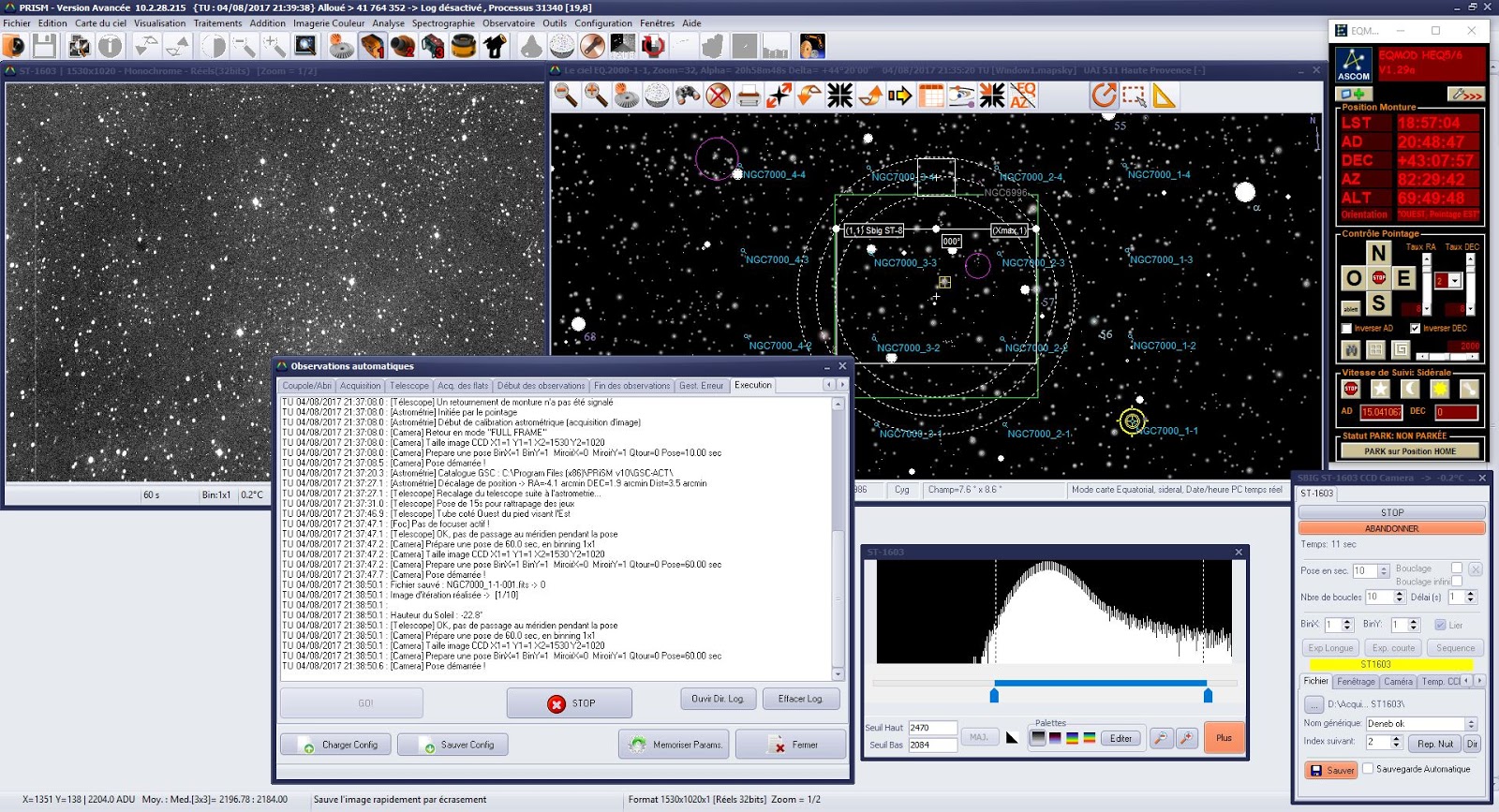
Here is a mosaic of North America I recorded the night of august 4th (automatic observation with Prism v10) using the TV85/NEQ6/ST1603 setup. I acquired a 4x4 mosaic (10x60sec exposures each) to fit this large nebula.
Preprocessing was done with Prism in one clic. To convert all my images to JPG and crop the useful area, I used the following script:
Then I simply assembled the JPG images using Windows Image Composite Editor:
equipment ready for observation
automatic observation with Prism v10
Preprocessing was done with Prism in one clic. To convert all my images to JPG and crop the useful area, I used the following script:
REM Conversion de FITS en JPG pour une mosaique par exemple
FileList=7
resetdlgbox
REM initialisation des parametres
adddlgbox FileList "Liste fichier FIT a convertir en JPG"
dispdlgbox ModalResult
if (ModalResult=1)
getdlgbox ListeFile$ NbFile
for i=1 NbFile
open img ListeFile[i]$
Window Img 30 30 1500 990
autovisu img
SAVEJPG img ListeFile[i]$+".jpg"
close img
next i
endif
Then I simply assembled the JPG images using Windows Image Composite Editor:
resulting image: 5008x3257 pixels
Field of view: 5.14° x 3.34° (7.72 arcsec/pixel)
vendredi 4 août 2017
Atmospheric sodium spectroscopy
There is a layer of atmosphere with sodium at around 80km above us which is excited by our Sun and makes an emission spectrum. Peter Schlatter gave me the idea to observe this phenomenon back at OHP few years ago.
During the day, it is not visible as the solar spectrum is too bright. During the night, this layer is not excited by solar rays But there is a transition phase when the Sun is ~6° below horizon. The sky spectrum switch from solar spectrum to night spectrum and the sodium appears in emission from this layer during a short period (around 15-20 minutes).
Here are the spectra obtained with the echelle spectrograph:
As time goes (from bottom to the top), the absorption is filled up and raise in emission to get lost into the noise as the solar spectrum disapear and the night is ready for some more stellar spectropscopy!
During the day, it is not visible as the solar spectrum is too bright. During the night, this layer is not excited by solar rays But there is a transition phase when the Sun is ~6° below horizon. The sky spectrum switch from solar spectrum to night spectrum and the sodium appears in emission from this layer during a short period (around 15-20 minutes).
Here are the spectra obtained with the echelle spectrograph:
As time goes (from bottom to the top), the absorption is filled up and raise in emission to get lost into the noise as the solar spectrum disapear and the night is ready for some more stellar spectropscopy!
jeudi 3 août 2017
Titan mount back to business !
After several months wihout observation as my Losmandy Titan mount was getting worse and worse in pointing & guiding, I got couple of days ago my refurbished mount and installed it last night. It run smoothly, I really enjoy this "new" mount!!!
It took me some time to reassemble and polar aligne the mount. I did a simplified model with 3 stars only but it is working ok. Guiging is smooth and next test should be a 5-6 hours autoguiding on the same object (BW Vul would be a nice target for this; CY Aqr too?).
I also adjusted the scope & counter weigh balance by removing the motors and "sensing" the force by turning the gear manually - it seemed to work very well and reduce the "motor lags" I had at the beginning.
It also took time to complete Prism v10 installation on my new PC. I adjusted the autoguiding parameters:
-increased the maximum shift to continue to next exposure (1 pixel by default; I did put 10 pixels)
-use full frame for guiding and not a cropped window so I could see the full image (but I may change this later)
-reduce the strength on both axis from 0.7 to 0.3
-set the guide star finding area to 100 pixels wide
-set the X/Y consigned position of course
-set the cross grid on the image (I kept the guiding image without MirrorX or Mirror Y to avoid trouble with the grid; image is inverted E/W but it is not critical for the observations)
The eShel was surprisingly still in good focus/position so I didn't touch it. I did a quick session on P Cygni but sky was getting cloudy so I didn't pursue other targets.
Note the better resolution on P Cygni. I checked the logs and the Halpha resolution has been improved by 40% (one line measurement in Prism) or 26% (order 34, with Halpha, measurement by ISIS) with better echelle spectrograph focus:
The Belle Etoile observatory is back for observations!
It took me some time to reassemble and polar aligne the mount. I did a simplified model with 3 stars only but it is working ok. Guiging is smooth and next test should be a 5-6 hours autoguiding on the same object (BW Vul would be a nice target for this; CY Aqr too?).
I also adjusted the scope & counter weigh balance by removing the motors and "sensing" the force by turning the gear manually - it seemed to work very well and reduce the "motor lags" I had at the beginning.
It also took time to complete Prism v10 installation on my new PC. I adjusted the autoguiding parameters:
-increased the maximum shift to continue to next exposure (1 pixel by default; I did put 10 pixels)
-use full frame for guiding and not a cropped window so I could see the full image (but I may change this later)
-reduce the strength on both axis from 0.7 to 0.3
-set the guide star finding area to 100 pixels wide
-set the X/Y consigned position of course
-set the cross grid on the image (I kept the guiding image without MirrorX or Mirror Y to avoid trouble with the grid; image is inverted E/W but it is not critical for the observations)
New PC for the observatory
Refurbished Losmandy Titan mount, now reinstalled in the dome
The eShel was surprisingly still in good focus/position so I didn't touch it. I did a quick session on P Cygni but sky was getting cloudy so I didn't pursue other targets.
Observing P Cygni with the eShel spectrograph
Comparison of P Cygni spectrum to last year and two years ago spectra
Note the better resolution on P Cygni. I checked the logs and the Halpha resolution has been improved by 40% (one line measurement in Prism) or 26% (order 34, with Halpha, measurement by ISIS) with better echelle spectrograph focus:
Octobre 2016:
=============
Raie ordre 34: X=584.870p ±0.021 Y=873.632p ±0.024 FWHML= 5.45p FWHMH= 4.76p
Resolution :
Order #31 : FWHM = 4.74 - Dispersion = .195 A/pixel - R = 7849.6
Order #32 : FWHM = 4.97 - Dispersion = .187 A/pixel - R = 7545.1
Order #33 : FWHM = 4.50 - Dispersion = .185 A/pixel - R = 8159.9
Order #34 : FWHM = 4.24 - Dispersion = .179 A/pixel - R = 8684.3
Order #35 : FWHM = 3.85 - Dispersion = .174 A/pixel - R = 9577.6
Order #36 : FWHM = 3.56 - Dispersion = .169 A/pixel - R = 10380.5
Order #37 : FWHM = 3.42 - Dispersion = .163 A/pixel - R = 10852.7
Order #38 : FWHM = 3.48 - Dispersion = .159 A/pixel - R = 10660.6
Order #39 : FWHM = 3.23 - Dispersion = .158 A/pixel - R = 11260.1
Order #40 : FWHM = 3.41 - Dispersion = .152 A/pixel - R = 10836.0
Order #41 : FWHM = 3.31 - Dispersion = .149 A/pixel - R = 11112.9
Order #42 : FWHM = 3.33 - Dispersion = .145 A/pixel - R = 11033.4
Order #43 : FWHM = 3.10 - Dispersion = .145 A/pixel - R = 11582.7
Order #44 : FWHM = 3.19 - Dispersion = .140 A/pixel - R = 11440.3
Order #45 : FWHM = 3.42 - Dispersion = .134 A/pixel - R = 10866.1
Order #46 : FWHM = 3.59 - Dispersion = .133 A/pixel - R = 10204.1
Order #47 : FWHM = 3.46 - Dispersion = .129 A/pixel - R = 10733.1
Order #48 : FWHM = 3.62 - Dispersion = .126 A/pixel - R = 10274.2
Order #49 : FWHM = 4.28 - Dispersion = .126 A/pixel - R = 8509.3
Order #50 : FWHM = 4.42 - Dispersion = .119 A/pixel - R = 8557.2
Order #51 : FWHM = 4.75 - Dispersion = .115 A/pixel - R = 8043.9
Order #52 : FWHM = 5.37 - Dispersion = .115 A/pixel - R = 7013.3
Order #53 : FWHM = 5.49 - Dispersion = .113 A/pixel - R = 6846.3
Août 2017:
==========
Raie ordre 34: X=586.435p ±0.011 Y=863.402p ±0.013 FWHML= 3.64p FWHMH= 2.98p
Resolution :
Order #31 : FWHM = 4.16 - Dispersion = .194 A/pixel - R = 8980.8
Order #32 : FWHM = 3.81 - Dispersion = .187 A/pixel - R = 9845.8
Order #33 : FWHM = 3.49 - Dispersion = .185 A/pixel - R = 10526.8
Order #34 : FWHM = 3.34 - Dispersion = .180 A/pixel - R = 10956.4
Order #35 : FWHM = 3.29 - Dispersion = .174 A/pixel - R = 11217.7
Order #36 : FWHM = 3.09 - Dispersion = .170 A/pixel - R = 11888.8
Order #37 : FWHM = 3.44 - Dispersion = .164 A/pixel - R = 10776.8
Order #38 : FWHM = 3.55 - Dispersion = .160 A/pixel - R = 10401.9
Order #39 : FWHM = 3.32 - Dispersion = .158 A/pixel - R = 10970.7
Order #40 : FWHM = 3.64 - Dispersion = .153 A/pixel - R = 10060.0
Order #41 : FWHM = 3.66 - Dispersion = .149 A/pixel - R = 10060.4
Order #42 : FWHM = 3.96 - Dispersion = .145 A/pixel - R = 9293.9
Order #43 : FWHM = 3.32 - Dispersion = .146 A/pixel - R = 10810.0
Order #44 : FWHM = 3.60 - Dispersion = .140 A/pixel - R = 10146.0
Order #45 : FWHM = 3.51 - Dispersion = .135 A/pixel - R = 10487.7
Order #46 : FWHM = 3.46 - Dispersion = .133 A/pixel - R = 10575.9
Order #47 : FWHM = 3.45 - Dispersion = .128 A/pixel - R = 10787.6
Order #48 : FWHM = 3.38 - Dispersion = .126 A/pixel - R = 10996.2
Order #49 : FWHM = 3.76 - Dispersion = .125 A/pixel - R = 9711.4
Order #50 : FWHM = 3.85 - Dispersion = .119 A/pixel - R = 9803.9
Order #51 : FWHM = 4.16 - Dispersion = .115 A/pixel - R = 9195.6
Order #52 : FWHM = 4.79 - Dispersion = .115 A/pixel - R = 7836.8
Order #53 : FWHM = 5.14 - Dispersion = .113 A/pixel - R = 7315.4
The Belle Etoile observatory is back for observations!
vendredi 28 juillet 2017
OHP2017 - The day I (almost) discovered a new variable star !
During OHP 2017 spectroscopy workshop, I used my small Televue 85mm on the NEQ6 mount with a ST1603 CCD camera.
I tried to mount a guiding camera but it didn't work: I needed some spacer to be able to focus both camera and I have to admit the off axis guiding module is very thin and doesn't leave lot of space for the camera. I do not really like the use of it but maybe once I got the right spacers, it will be ok...
Anyway, I played with Prism v10 software and acquired some images of CY Aqr, a pulsating (delta Scuti type) variable star. The screenshot below shows the run during the night. The maximum ADU count was measured inside a small box and without (auto)guiding, the star moved out of this box so the count dropped for some time. I moved the star back inside later on (well... I slept some time during those acquisitions!).
Prism software has a photometry module which is fairly simple to use (once I changed the catalog from GSC to GSC-ACT which is the one installed with Prism!). This module extract all the stars, look for the best references and map all the stars on a graph with magnitude & RMS. The stars should all be on a "main sequence" except the one which are variable!
I quickly looked at CY Aqr and result shows a very nice light curve, which can be improved by better selecting the variable stars and enlarging a little bit the measurement area:
Anyway, I noticed a star whose magnitude varies in a nice shape:
YES! This is a variable star which isn't indicated on Prism and the GVSC (Global Variable Star Catalog)!!! The star is GSC0567-1919. So I took images during an other night at OHP and a third night from home with the same setup. I sent the measurements to Raoul Behrend (managing asteroid rotation curves in Europe and variable star light curves) and Romain Montaigut (from CALA local club). They made some check and (unfortunatly) the variable is already known as VSX122414:
The light curve is very nice and this shows how to look at your pictures to search for new variable stars!
I tried to mount a guiding camera but it didn't work: I needed some spacer to be able to focus both camera and I have to admit the off axis guiding module is very thin and doesn't leave lot of space for the camera. I do not really like the use of it but maybe once I got the right spacers, it will be ok...
Anyway, I played with Prism v10 software and acquired some images of CY Aqr, a pulsating (delta Scuti type) variable star. The screenshot below shows the run during the night. The maximum ADU count was measured inside a small box and without (auto)guiding, the star moved out of this box so the count dropped for some time. I moved the star back inside later on (well... I slept some time during those acquisitions!).
Prism software has a photometry module which is fairly simple to use (once I changed the catalog from GSC to GSC-ACT which is the one installed with Prism!). This module extract all the stars, look for the best references and map all the stars on a graph with magnitude & RMS. The stars should all be on a "main sequence" except the one which are variable!
I quickly looked at CY Aqr and result shows a very nice light curve, which can be improved by better selecting the variable stars and enlarging a little bit the measurement area:
Anyway, I noticed a star whose magnitude varies in a nice shape:
YES! This is a variable star which isn't indicated on Prism and the GVSC (Global Variable Star Catalog)!!! The star is GSC0567-1919. So I took images during an other night at OHP and a third night from home with the same setup. I sent the measurements to Raoul Behrend (managing asteroid rotation curves in Europe and variable star light curves) and Romain Montaigut (from CALA local club). They made some check and (unfortunatly) the variable is already known as VSX122414:
The light curve is very nice and this shows how to look at your pictures to search for new variable stars!
mardi 25 juillet 2017
OHP2017 - Mosaic with Prism v10
During OHP 2017, I used my small Televue 85mm refractor on a NEQ6 mount with a ST1603xme CCD camera.
In Prism v10, you can use the automatic observation to acquire multiple images to do a mosaic. In Observatory menu, select "objects to observe list" then create a list of targets around your object to acquire the mosaic.
In this exemple, I am targetting the Veil nebula so I used the coordinates of a star between the two nebulae.
After having created my observation list (3x3 images around Veil nebula), I used the automatic observation tool to acquire all the images, 15 exposures for each section. Here are the screenshots for M31 and M45 mosaics:
I reduced each section (actually, in Prism, you just process everything and each section is preprocessed independantly) and export them as JPG images using the same visualization levels.
I tried Prism tool to assemble the images but it didn't work (alignment were not very good) so I used ICE (Image Composite Editor), a free Windows 10 tool to do panorama. It worked very well on the Veil nebulae, less on M31. Here is the result on the Veils - a nice picture with a very large field of view:
In Prism v10, you can use the automatic observation to acquire multiple images to do a mosaic. In Observatory menu, select "objects to observe list" then create a list of targets around your object to acquire the mosaic.
In this exemple, I am targetting the Veil nebula so I used the coordinates of a star between the two nebulae.
After having created my observation list (3x3 images around Veil nebula), I used the automatic observation tool to acquire all the images, 15 exposures for each section. Here are the screenshots for M31 and M45 mosaics:
I reduced each section (actually, in Prism, you just process everything and each section is preprocessed independantly) and export them as JPG images using the same visualization levels.
I tried Prism tool to assemble the images but it didn't work (alignment were not very good) so I used ICE (Image Composite Editor), a free Windows 10 tool to do panorama. It worked very well on the Veil nebulae, less on M31. Here is the result on the Veils - a nice picture with a very large field of view:
lundi 24 juillet 2017
OHP2017: Automatic observations with PRISM v10
Every year, a group of spectroscopists gather together at Observatory of Haute Provence. This year, more than 50 people joined this world class spectroscopy star party with around 30 telescopes in the field!
I brought a NEQ6 mount for Steve Shore (a professional astronomer from Pisa university, who came to give us several astrophysics courses) students. They were very autonomous so I did setup my second NEQ6 mount with a small Televue 85mm refractor and a Zwo ASI178MC color CMOS camera.
The Zwo ASI 178MC is a low cost camera which works very well for astronomy with small exposures (less than 30sec typically). File size is fairly large as this is a ~3000x2000 pixel image with a Bayer color matrix. While well adapted for some visual assisted astronomy, it is not designed for science.
PRISM v10 includes a very powerful automatic observation tool. I played with it and basically loved it. It is very easy to use and I was able to acquire several objects in Sagittarius with very few clicks.
The process worked very well except that the TV85 defocused itself after some time and I have no motorized focuser.
Preprocessing, image alignment and addition took lot of time due to the large number of images and large file size. Result is still satisfactory, specially as the Zwo ASI178MC camera is fairly low cost:
OHP 2017 group picture
I brought a NEQ6 mount for Steve Shore (a professional astronomer from Pisa university, who came to give us several astrophysics courses) students. They were very autonomous so I did setup my second NEQ6 mount with a small Televue 85mm refractor and a Zwo ASI178MC color CMOS camera.
Alessandra, Marco, Marco & Giovanni
The Zwo ASI 178MC is a low cost camera which works very well for astronomy with small exposures (less than 30sec typically). File size is fairly large as this is a ~3000x2000 pixel image with a Bayer color matrix. While well adapted for some visual assisted astronomy, it is not designed for science.
my own equipment at OHP
PRISM v10 includes a very powerful automatic observation tool. I played with it and basically loved it. It is very easy to use and I was able to acquire several objects in Sagittarius with very few clicks.
The process worked very well except that the TV85 defocused itself after some time and I have no motorized focuser.
Preprocessing, image alignment and addition took lot of time due to the large number of images and large file size. Result is still satisfactory, specially as the Zwo ASI178MC camera is fairly low cost:
M22 (Trifid) nebula
M8 (Laguna) nebula
M17 (the Swann) nebula
M16 nebula
M22 globular cluster
M11 open cluster
M15 globular cluster
M39 open cluster
M30 cluster
M34 cluster
NGC7331 galaxy in Pegasus
Inscription à :
Articles (Atom)